Unit 4 Reflection
In this lab, we used coins to demonstrate the randomness of genes to get passed down to the next generation of organisms through sex. Coins served as a model for this genetics concept well, because it simulates the 50:50 probability of passing genes down well, as coins only have two outcomes, heads or tails. My expected results were quite similar to my actual results, and the last experiment that I made was almost exactly what my predictions were. The closeness to my predictions showed that the probability that I predicted was very close to what might actually happen, but it also shows how predictions don't always match the exact result. It's only a tool to estimate the results of what percentage of certain offspring might get certain traits. The limit of using probability to predict is that it doesn't always come up with the correct predictions. It only dictates the outcome that is most likely, and obviously, there are many different outcomes when it comes to the traits of one's offspring. Understanding this relates to my life because if I wanted to have children that were free of genetic diseases, I would test my partner's genetic alleles and mine and see if there were any genetic diseases my future children might inherit, and if so, what the probability of it happening, whether it be through autosomal or X-linked inheritance. This is also relevant to my future life, because it is important to remember that X-linked diseases effect men more than it does woman, because men only have one X chromosome. Even if both my partner nor I had said X-linked diseases, it could be possible that she might be heterozygous for an X-linked diseases, being a carrier of a recessive X-linked diseases, thus all my future homozygous sons, since they only need one copy of the trait to be affected had a risk of getting the X-linked disease. Tools such as monohybrid or dihybrid crosses can be used to predict results of simple traits in our genotype to determine, after meiosis and gene segregation, what our genetic recombinations might yield.
This unit was about reproduction in living things and how important it was. The themes and essential understandings were how sexual reproduction had been a very important part of most advanced animal life on Earth. My strengths and successes in this chapter include the fact that I am very good at memorizing things, and new information is not hard for me to retain. My weaknesses and setbacks included that it was hard for me to get used to this subject that I felt was too explicit and inappropriate to be learned in a 9th grade biology classroom. Nevertheless, I gradually got used to it, and I was quite up to pace with the class by the end of the unit.
I learned quite a bit from the vodcasts and the projects that we did in this unit, such as the genetics infographic. I learned that genetics was actually a lot more complicated and less black and white when it came to inheritance. In his discoveries, Mendel overlooked a lot of genetic complications, either through luck or design. This made me realize that the world of genetics is a lot mode complicated that what I first learned in seventh grade. In other words, this taught me a lot about what I didn't know I didn't know, an essential step when it comes to learning a new topic.
The only other few unanswered questions that I have without diving into the many different complications of inheritance is why the cell knows how to function and why it knows to do what when. We know basically what a cell does now, but there are still many questions related to how the cell "knows" certain things.
This is a link to My Genetics Infographic:
This unit was about reproduction in living things and how important it was. The themes and essential understandings were how sexual reproduction had been a very important part of most advanced animal life on Earth. My strengths and successes in this chapter include the fact that I am very good at memorizing things, and new information is not hard for me to retain. My weaknesses and setbacks included that it was hard for me to get used to this subject that I felt was too explicit and inappropriate to be learned in a 9th grade biology classroom. Nevertheless, I gradually got used to it, and I was quite up to pace with the class by the end of the unit.
I learned quite a bit from the vodcasts and the projects that we did in this unit, such as the genetics infographic. I learned that genetics was actually a lot more complicated and less black and white when it came to inheritance. In his discoveries, Mendel overlooked a lot of genetic complications, either through luck or design. This made me realize that the world of genetics is a lot mode complicated that what I first learned in seventh grade. In other words, this taught me a lot about what I didn't know I didn't know, an essential step when it comes to learning a new topic.
The only other few unanswered questions that I have without diving into the many different complications of inheritance is why the cell knows how to function and why it knows to do what when. We know basically what a cell does now, but there are still many questions related to how the cell "knows" certain things.
Here I have linked certain pictures that I found related to the 4th unit:
 |
| The Process of Meiosis |
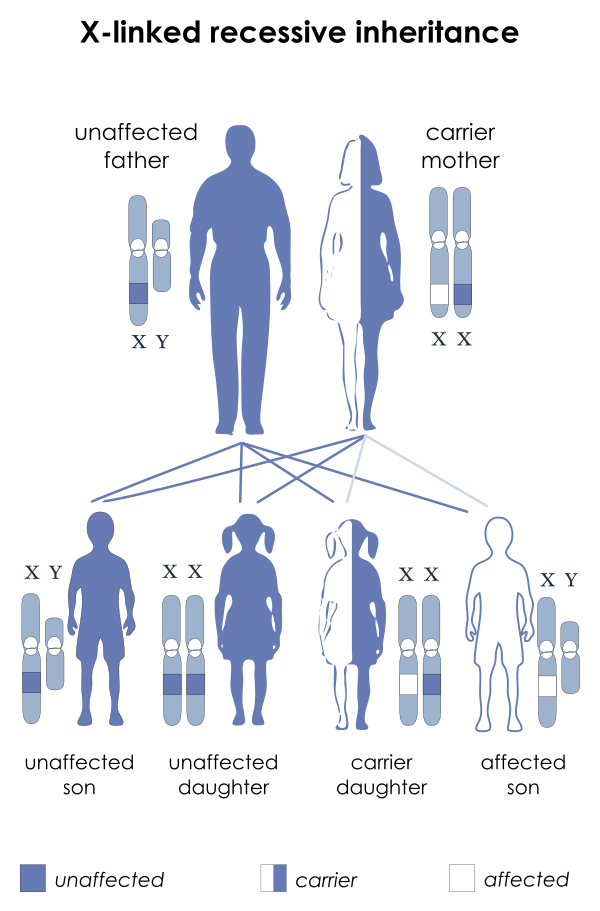 |
| Example of how X-linked diseases can be hidden |
https://magic.piktochart.com/output/18370332-genetics-infographic


Comments
Post a Comment